
Hello CPAs and Tax Pros! Meet Brandon...Your 'Go-To' in the Cost Seg Biz! He's No Superhero...But He Does Wield Powerful Cost Seg Strategies to Help Obliterate Your Clients Tax Liability!


Client Question: What is a Cost Segregation Study?
Cost Segregation is a powerful tax strategy that helps real estate owners cut down their income tax liability by pinpointing and reclassifying parts of a property from long-life real estate to shorter-life personal property. In plain English? It lets you give certain building components a “faster aging schedule,” which accelerates depreciation deductions and unlocks tax savings much sooner than traditional methods. The result: improved cash flow, boosted ROI, and the satisfying feeling of legally outsmarting the IRS...kind of like finding a cheat code in the tax world, but fully approved.
- CPA Summary - Cost Segregation is a Defensible Way to Accelerate Depreciation -2-00:00
Client Question: Who Does Cost Segregation Studies?
Cost Segregation Studies are typically performed by specialized firms that combine engineering principles, tax law, and real estate expertise. These teams often include engineers, construction professionals, and CPAs who analyze a property in detail to identify and reclassify assets for accelerated depreciation. While a CPA can recognize when a study is needed, only trained Cost Segregation Specialists (with engineering-based methodologies and IRS-compliant documentation) should conduct the actual analysis to ensure accuracy, maximum tax savings, and full IRS support.
- CPA Summary - Cost Segregation is a Collaborative Play00:00
Client Question: Can Cost Segregation Offset W-2 Income?
Yes...but only under the right IRS rules. For most taxpayers, Cost Segregation creates passive losses, which can offset passive income but not W-2 wages. However, there are a few key exceptions that allow those deductions to cross over:
Bottom line:
Cost Segregation can offset W-2 income, but only if you qualify under specific IRS rules. The strategies are powerful, the details matter, and the IRS keeps a close eye on the distinctions between passive and active activity.
- CPA Summary for Offsetting W-2 Income with Cost Seg00:00

Client Question: Can You Do Cost Segregation on Residential Rental Property?
Yes, Cost Segregation can be applied to residential rental properties (not just commercial property)...as long as they're used for rental or income generation (and not as your primary home…the IRS draws a firm line there). This includes apartment complexes, multifamily buildings, and in many cases, single-family or short-term rentals.
The process works by breaking the property into individual components...like flooring, cabinetry, wiring, and plumbing...that can be depreciated over shorter timelines than the standard 27.5-year schedule for residential property.
Translation: faster depreciation and earlier tax benefits, all while staying squarely within IRS guidelines.
That said, the biggest benefits show up with higher-value properties or owners who have taxable income to offset. A $90,000 condo might not move the needle much...but a $750,000+ rental property? That’s where Cost Segregation starts to earn its keep.
- CPA Summary for Residential Rental Properties00:00
- CPA Summary for Air BnB Properties00:00


Client Question: What Properties Are Best for Cost Segregation?
The best properties for Cost Segregation are large, income-producing commercial and multifamily buildings, especially those that are newly purchased, recently built, or significantly renovated. These properties contain more components that qualify for accelerated depreciation, making this tax strategy more impactful and cost-effective.
Commercial real estate...such as hotels, restaurants, office buildings, retail centers, medical facilities, warehouses, climate controlled self-storage properties, and mobile home parks...tends to deliver the strongest results because of its complexity. Think of these buildings as tax Swiss Army knives: lots of moving parts like wiring, lighting, HVAC, flooring, and specialty systems that can be depreciated faster.
Multifamily properties with five or more units are also excellent candidates. More units mean more plumbing, appliances, interior finishes, and site work, all of which create additional depreciation opportunities. In general, properties with a purchase price of $1 million or more see the best return on a Cost Segregation Study.
Strong candidates typically include:
Recently purchased, built, or renovated properties
Commercial and multifamily real estate
Properties with significant interior or system upgrades
Owners with substantial taxable income who can use the deductions
In short, if a property is big, busy, and built for income, it’s probably a very strong fit for Cost Segregation...and much better than letting depreciation crawl along at a snail's pace of 27.5- or 39-year depreciation.
- CPA Summary - Where Does Cost Seg Deliver the Most Value00:00
Client Question: Is Cost Segregation Worth It?
For many commercial and real estate investors, yes...Cost Segregation is absolutely worth it when done correctly. Cost Segregation is an IRS-approved tax strategy that accelerates depreciation by identifying parts of a building that depreciate faster than the structure itself. By reclassifying certain components into shorter depreciation lives, property owners can increase deductions, reduce current tax liability, and improve cash flow...often significantly.
Cost Segregation typically makes sense if:
You own commercial or income-producing residential property
The purchase price or construction cost is $500,000 or more
You have taxable income to offset
You plan to hold the property for several years
If your property is small, already generating losses, or about to be sold, Cost Segregation may be perfectly legal...but poorly timed.
When performed using an engineering-based study and proper documentation, Cost Segregation is well supported by IRS guidelines and court rulings. Problems usually arise from shortcut studies...not from the strategy itself.
Cost Segregation is worth it when the tax savings exceed the cost of the study and it aligns with your overall tax strategy. When those conditions are met, the question usually becomes:
“Why didn’t I do this sooner?”
A quick feasibility analysis can determine whether Cost Segregation makes sense for your property—before you commit.
 |
Client Question: Cost Seg and Bonus Depreciation... What's the Diff?
Cost Segregation and bonus depreciation are often mentioned together...and for good reason. They work hand in hand, but they are not the same thing. The easiest way to think about it? Cost Segregation finds the deductions. Bonus depreciation accelerates them.
Cost Segregation is an IRS-approved tax strategy that breaks a property into components with shorter depreciation lives. Instead of depreciating the entire building over 27.5 or 39 years, certain assets...like electrical, plumbing, flooring, and site improvements...are reclassified into 5-, 7-, or 15-year property.
Translation: more depreciation sooner.
Bonus depreciation determines how quickly those reclassified assets can be written off. When available, it allows qualifying property components identified through cost segregation to be deducted faster—often heavily in the first year the property is placed in service. Cost Segregation creates the opportunity. Bonus depreciation controls the timing.
Cost Segregation and bonus depreciation serve different purposes, but together they can significantly reduce current tax liability and improve cash flow for qualifying property owners.
Using bonus depreciation without Cost Segregation may mean missing deductions. Using Cost Segregation without understanding bonus depreciation may mean missing timing advantages. A proper analysis shows how both strategies work together—and whether they’re worth it for your property.

Client Question: How Much Does a Cost Segregation Study Cost?
A Cost Segregation Study typically runs $4,000 to $15,000+, depending on the size and complexity of the property.
While that’s a meaningful investment, it’s typically small compared to the tax savings it unlocks. Many investors see benefits that are 5–20x the fee, making it one of the highest-ROI decisions you can make for your property. It’s not an expense...it’s a strategy.
The IRS isn’t going to voluntarily hand you the deductions you’re missing. A Cost Segregation Study simply makes sure you’re not leaving them on the table.
 |
Client Question: How Does Cost Segregation Work?
Cost Segregation works by breaking your building into pieces...not physically (don’t worry, no sledgehammers involved)...but on paper.
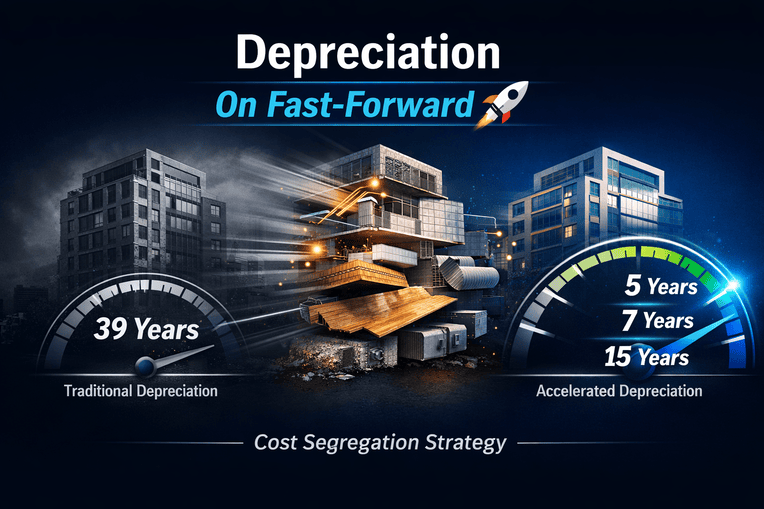
Instead of depreciating the entire property over 27.5 or 39 years, we identify components like flooring, lighting, wiring, and certain improvements that the IRS allows to be depreciated over 5, 7, or 15 years.
The result? You accelerate depreciation, increase deductions, and improve cash flow...all by classifying things correctly. Think of it like putting your building on a faster depreciation treadmill…without actually making it run.
 |
Quit Digging for Deductions with a Plastic Spoon...Cost Segregation Brings Out the Excavator!

Client Question: What Started Cost Segregation?
Cost Segregation started the same way many great tax strategies do...someone read the fine print.
Back in the 1970s and 80s, engineers and tax pros realized that not every part of a building should be treated the same for depreciation. Carpet isn’t the same as concrete. Specialty wiring isn’t the same as structural steel. And thankfully, the IRS eventually agreed.
A few landmark court cases confirmed that certain components could be depreciated faster...and just like that, Cost Segregation was born.
So no, it wasn’t a loophole. It was a clarification. A very profitable clarification.
Client Question: What are the Downsides of Cost Segregation?
First, it’s not free. A Cost Seg Study typically costs several thousand dollars. (The good news? The ROI usually makes that sting go away pretty quickly...and the cost to do a study is also a tax deduction.)
Second, you’re accelerating depreciation...which means you’re taking more deductions now and fewer later. If you sell, there can be depreciation recapture. Translation: the IRS may want to settle up on part of those earlier benefits.
Third, it requires proper documentation and a quality study. This is not a “napkin math” strategy. Done right, it’s powerful. Done wrong…it’s an audit invitation.
The bottom line? Cost Segregation isn’t magic...it’s timing. You’re moving deductions forward to improve cash flow today. For most investors, that’s a feature, not a flaw.

Client Question: Do You Have to Pay Back Cost Segregation?
Short answer: No
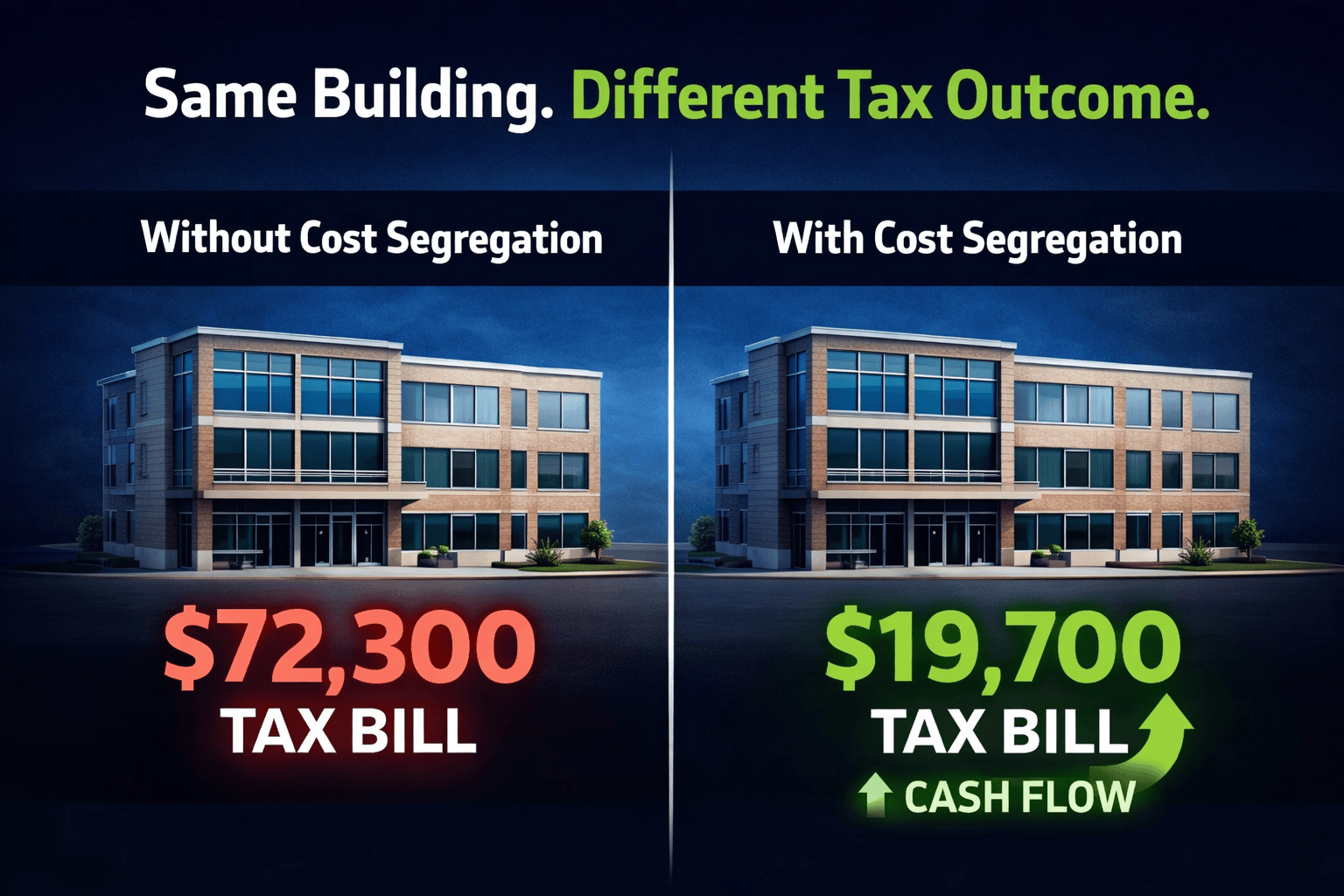
You don’t “pay back” Cost Segregation like a loan. The IRS isn’t sending you a monthly invoice. What you’re doing is accelerating depreciation...taking more deductions now instead of spreading them out over decades.
If you sell the property, there can be depreciation recapture, which means the IRS may tax part of those earlier deductions. But that’s not a penalty...it’s just settling up on the timing difference.
Think of it like this: Cost Segregation lets you use the government’s money sooner. And if you keep the property long-term or use strategies like a 1031 exchange...you may defer that recapture even further.
So no, you don’t “pay it back.” You just eventually reconcile the timing...ideally after you’ve put that extra cash flow to good use.
Client Question: Can You Sell a Property After Cost Segregation?
Absolutely. Cost Segregation doesn’t lock your property in a vault. You can sell whenever you’d like. The only catch? If you sell, there may be depreciation recapture...meaning the IRS wants to tax part of the accelerated depreciation you took earlier. It’s not a penalty. It’s more like the IRS saying, “Hey, remember that head start we gave you?”
The good news: you kept the extra cash flow upfront...and smart investors often use that money to reinvest, grow, or even roll into a 1031 exchange to defer the recapture.
So yes, you can sell after Cost Segregation. Just don’t be surprised if the IRS wants to chat about the timing.
Straight-Line Depreciation Is SLOW....Like Towing a Freight Train with a Bicycle...Help Your Clients Speed Up Depreciation with Cost Segregation!

Client Question: Can You Write Off a Cost Segregation Study?
Yes...and this is the part people love. In most cases, the fee for a Cost Segregation Study is tax deductible as a professional expense. So yes, you can often write off the study that helps you write off more of your building.
It’s basically a deduction that helps create bigger deductions. Very meta. Very efficient.
Always confirm with your CPA, of course...but it’s one of the few investments where even the invoice is working in your favor.
Client Question: What is the Cost Segregation Study Loophole?
The “Cost Segregation Loophole” is one of those phrases that sounds scandalous…but really isn’t. There’s no secret backdoor or IRS glitch. It’s simply applying existing tax law correctly. The tax code allows certain parts of a building (like flooring, lighting, wiring, and land improvements) to depreciate faster than the structure itself. Cost Segregation just identifies and classifies those components properly.
So it’s not a loophole. It’s math. Very detailed, engineering-heavy, IRS-approved math.If anything, the real loophole would be not using rules that are already sitting there in black and white.
Cost Segregation is just telling the IRS, "Hey...this building ages faster than you think."

Client Question: When Can You do a Cost Segregation Study?
Short answer: sooner than most people think.
You can do a Cost Segregation Study when you buy, build, or renovate a property...and even years after the fact. Yes, really. The IRS allows a “look-back” study, so you can catch up on missed depreciation without amending prior returns. (It’s basically the tax version of “better late than never.”)
But of course..."better never late." Ideally, you do it in the first year to maximize cash flow. But if you’ve owned the property for a while? It’s not too late.
When it comes to accelerating depreciation, the best time was year one…the second-best time is now.

Client Question: What Does Cost Segregation Mean?
Cost Segregation means your building isn’t just “a building.”
Instead of lumping the whole thing together and depreciating it over 27.5 or 39 years, Cost Segregation breaks it into parts...things like flooring, lighting, cabinetry, wiring, parking lots...and assigns shorter depreciation lives where the IRS allows.
In plain English?
It’s taking your property apart on paper (no hard hats required) so you can accelerate depreciation and improve cash flow.
Same building. Same tax code. Just smarter classification.
Client Question: How to do a Cost Segregation Study?
Step one: Don’t grab a hammer.
A Cost Segregation Study isn’t DIY home improvement...it’s an engineering-based tax analysis. The process typically involves reviewing construction documents, invoices, blueprints, and an IRS recommended site visit to identify components that qualify for shorter depreciation lives.
Engineers break the property into parts. Tax pros apply the rules. Your CPA files the form.
Could you try to do it yourself? Technically.
Should you? Only if you also perform your own dental work.
Done right, it’s detailed, defensible, and IRS-compliant...and it can unlock significant accelerated depreciation.

Client Question: How to Apply Cost Segregation on a Tax Return?
Short answer: you don’t just “check a box.”
After a Cost Segregation Study is completed, your CPA applies the reclassified assets to your depreciation schedule and files Form 3115 (if it’s a look-back study) to catch up on missed depreciation.
Translation: the engineers do the breakdown, the tax pros do the paperwork, and you enjoy the accelerated deductions.
Could you try to wing it in TurboTax? Technically.
Should you? Only if you enjoy love letters from the IRS.
This is one of those strategies where precision matters...but once it’s applied correctly, the tax savings show up exactly where they should: on your bottom line.
Client Question: Can Cost Segregation Offset Capital Gains?
Short answer: not directly...but it can definitely help the overall tax picture.
Cost Segregation accelerates depreciation, which can create larger losses in the early years. Those losses may offset ordinary income (if you qualify as a real estate professional or have passive income to absorb them).
But capital gains from selling a property? That’s a different lane.
When you sell, you may actually face depreciation recapture on the accelerated portion. (Yes, the IRS keeps receipts.)
Now here’s where strategy comes in: pair Cost Segregation with a 1031 exchange, and you may defer both capital gains and recapture. That’s when the chess game gets interesting.
So no, Cost Segregation isn’t a magic “erase capital gains” button... but in the right strategy, it can be a powerful move on the board.
Client Question: When Does Cost Segregation Make Sense?
Cost Segregation makes sense when three things are true:
You own (or just bought) investment real estate.
The property has meaningful value (typically $500K+).
You’d rather keep cash in your pocket than send it to the IRS early.
It makes the most sense when you have strong taxable income to offset and plan to hold the property for a while. That’s when accelerating depreciation can seriously boost cash flow.
It probably doesn’t make sense if the property is tiny, you’re selling next week, or you don’t have income to absorb the deductions.
In simple terms: If you like improved cash flow and strategic tax timing, Cost Segregation makes a lot of sense.
If you enjoy writing larger checks to the IRS ahead of schedule…you can skip it.
With Cost Segregation, Smart Investors Don't Avoid Taxes...They Control When They Pay Them.

Client Question: How to Choose the Best Cost Segregation Service Provider?
Choosing the best Cost Segregation provider is a little like choosing a surgeon. Yes, price matters…but experience matters more.
Look for a firm that uses engineers (not just spreadsheets), produces IRS-defensible reports, and has a track record of surviving audits. Ask how detailed their methodology is, whether they perform site visits, and how they support you if questions ever come up.
If their entire sales pitch is “we’re the cheapest,” that’s usually your cue to run. This isn’t discount dentistry.
The best provider delivers three things:
✔ Technical accuracy
✔ Audit support
✔ Clear ROI
Because when you’re reclassifying hundreds of thousands...or millions...of dollars, you don’t want guesswork. You want expertise.

Client Question: Can I Hire a Cost Segregation Expert Online for Remote Consultation?
Yes...and no, we don’t have to show up with hard hats and a ladder.
Most Cost Segregation firms can handle the majority of the process remotely.
Construction documents, invoices, depreciation schedules, and photos can all be reviewed digitally. Many studies today are done efficiently through secure online collaboration.
That said, high-quality Cost Seg firms may still perform a site visit as the IRS recommends... especially for larger or more complex properties...because details matter.
So yes, you can absolutely hire a Cost Seg expert online. Just make sure they’re bringing engineering expertise and audit-ready documentation…not just a Zoom background and a calculator.

Client Question: Where to Find Cost Segregation Consultants Near Me?
Short answer: closer than you think…and probably online.
You can find Cost Segregation consultants with a quick Google search, through referrals from your CPA, or by checking professional organizations like the ASCSP. Thanks to technology, they don’t have to be in your zip code to do great work.
That said, “near me” shouldn’t just mean geography...it should mean responsive, experienced, and audit-defensible.
Because when you’re reclassifying hundreds of thousands (or millions) of dollars, proximity is nice… but expertise is everything.



Client Question: How to Request a Cost Segregation Proposal from Service Providers?
Short answer: just ask...it’s not a marriage proposal.
Most Cost Segregation firms can give you a proposal with a few basic details: purchase price (or cost basis), property type, placed-in-service date, location, and whether there were renovations. Send that over, and they’ll typically provide a fee quote and estimated benefit.
No blueprints? No problem. No 200-page tax return? Also fine. This isn’t an IRS audit...it’s a conversation.
Pro tip: don’t just ask for price. Ask about methodology, engineering involvement, timeline, and audit support. Because the cheapest proposal isn’t always the smartest one. In other words, requesting a proposal is simple. Choosing the right one? That’s where you want to pay attention.

"Brandon is great to work with, quick response time and takes the time to make sure you understand everything. Great final results too! A+++"
Jonathan Harouni, Investor - 5 Star Google Review
"Brandon and his team are very professional, helpful, and...available for questions. I am a repeat customer and have referred others who have been very pleased as well."
Alison Abiri, Real Estate Investor - 5-Star Google Review

National Cost Segregation Services isn’t your typical “plug-it-into software” Cost Seg shop...we’re the engineering-geek squad making CPA firms and investors smile all the way to the bank!
We pair real construction know-how with tax strategy to break your building down the right way, not the lazy way, so you accelerate depreciation and keep more cash in your pocket.
Every study includes a site visit, engineer-driven analysis, and audit-ready documentation that’s compliant with IRS guidelines...because “trust us” isn’t a strategy the IRS accepts.
We work hand-in-hand with CPA and accountants throughout the United States and handle the Form 3115 when needed, giving your client full IRS protection and peace of mind from start to finish.
Think of us as your tax-saving pit crew and Cost Seg Sidekicks: we show up, take precise measurements, engineer the deductions, and hand you a report for your client's that is built to last...and built to defend.
If you’re serious about helping your clients who own property to crush tax liability and boost cash flow, we’re here to make sure your clients Cost Segregation Study isn’t just good…it’s audit-proof spectacular!